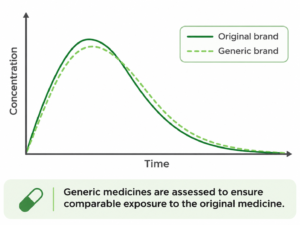
How do we know generic medicines work the same way?
Generic medicines must meet the relevant requirements to demonstrate that they provide the same therapeutic benefits as the original medicine. One of the important ways this is established is through bioequivalence.
Original brand
Same active ingredient and strength
Generic brand
Same active ingredient and strength
What does bioequivalence mean?
Bioavailability measures the rate and extent to which the active ingredient in a medicine reaches the body’s systemic circulation and is therefore available to be used by the body for a therapeutic purpose.
If two medicines are bioequivalent, there is no clinically significant difference in their bioavailability. That means the same amount of active ingredient reaches the necessary parts of the body for the therapeutic purpose in the same timeframe.
Before a generic medicine can be sold in Australia, the manufacturer must prove it is bioequivalent to the original brand. This evident is evaluated by the Therapeutic Goods Administration (TGA) before marketing approval is granted.
How is bioequivalence demonstrated?